













When the Manager Doesn’t See the Mirror: A Perspective on Bad Management and the Dunning-Kruger Blind Spot
by: Bill Grieve - Sat, 06 Sep 2025

In his monthly series for Bahrain This Month, Bill Grieve casts his civic lens on areas of concern, offering an enlightening and engaging perspective on various issues affecting life in the Kingdom.
In our business communities we have great managers in many areas who are the backbone of our productivity – but across the region, the world and everywhere – bad managers are no mystery. They are the ones subtly undermining performance yet never recognising the damage they do. Many of us know these managers all too well – but they don’t know it of themselves. Enter the Dunning-Kruger effect: a psychological blind spot where those with the least skill overestimate their abilities leading to poor performance. In our local workplaces, this combination can be quietly corrosive, and it gets worse when a manager is not competent, hired or appointed for the wrong reasons and does not work on bridging performance or knowledge gaps.
A Business Culture Not Built for Feedback – The traditional management style emphasises deference and respect for authority. Decisions are rarely questioned, and managers expect unquestioned loyalty. This paternalistic model – once a strength, is now exposed as a double-edged sword when humility and reflection are absent. In such environments, an overconfident manager is unlikely to hear criticisms, let alone respond to them.
Employees reflect leadership blind spots – micro-management, favouritism and confusion disguised as strength – hallmarks of an over-confident, under-aware management style at odds with effective leadership.
The Dunning-Kruger Effect Through an Experienced Management Lens – At its core, the Dunning-Kruger effect leads incompetent individuals to be unaware of their own shortcomings. In a collectivist society like ours, nuances emerge. Research from the UAE shows that bottom performers overestimate their abilities, while top performers tend to underestimate theirs. Extrapolated to the region, many bad managers likely believe they’re skilled because they see no obvious feedback – or any feedback at all.

The Damage in Our Own Backyard – Toxic leadership doesn’t just hurt morale – it can directly threaten businesses:
• Small businesses fail when leadership fails – perhaps due to a bad manager who never adapts.
• Teams burn out; one regional survey found that two-thirds of employees reported mental health struggles at work.
• Public sector investigations noted that misuse of temporary contracts and outsourcing – sometimes driven by short-sighted leadership – can harm long-term local workforce stability.
Who Holds the Mirror? If managers won’t reflect honestly, perhaps the workplace culture can:
1. Amplify the Employee Voice – Trade unions, business associations/societies, social media platforms and communication groups exist precisely to give workers leverage and visibility. Encouraging safe channels for feedback helps break the silence and the cycle.
2. Conduct Champion Transparent Leadership Training – Inspired leadership isn’t inherited. Transformational, emotionally intelligent styles must replace the old dysfunctional autocratic norms (my way or the highway). Business culture is shifting – and managers must shift with it.
3. Normalise Honest Reflection – Encourage anonymous 360-degree reviews or leadership journaling and personal reflective writing. These tools force self-awareness rather than smug self-delusion.
4. Reward Humility – Leaders who ask: “How can I improve?” should earn praise – not suspicion. Commercial and business policies aligned with public transparency push in this direction – however, soft skills matter just as much as quotas.
A Checklist for Managers: Do You Recognise Yourself? – Ask yourself as a manager:
• Do colleagues complain – privately or openly – that you’re inflexible or micromanaging?
• Are you making unscheduled changes or late – night calls that demoralise your team?
• Do you focus blame outward when things go wrong rather than ask: “How did I contribute?” or “What could I have done better and more to prevent this?”
• Are promotions and support given only to a clique – like loyalists – not based on merit?
• Do you claim competence but never ask: “Am I doing this right?”
• Is your lack of planning often the cause of your staff’s emergencies?
• Do you include the right people in planned actions? (The true position of a person in a company or organisation is reflected not by what they are involved in, but by what they are excluded from).

Bad managers aren’t always malicious. Often, they’re victims of their own blind confidence. In a traditionally hierarchical workplace culture, changed by multiculturalism, international management style and generational shifts all mean ignorance can be more damaging – because honest feedback is rare.
The Dunning-Kruger effect is less a label than a warning: “You might be wrong – and not even know it.” Our workplaces, our teams and our economy deserve leaders who can – or will – look at themselves honestly. If you’re a manager reading this, consider it a mirror. And if you work for one, consider submitting that feedback.
Only when we confront uncomfortable inconvenient truths about ourselves as managers can we change for the better.
And isn’t that what good leadership is really about?
Lead, follow or get out of the way…
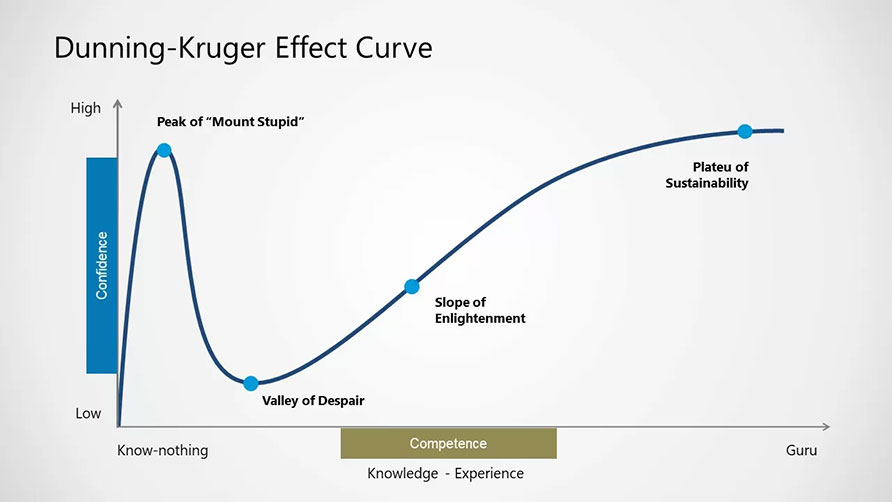
More on the Dunning-Kruger Effect (Visit below link):
https://en.m.wikipedia.org/wiki/Dunning%E2%80%93Kruger_effect

Digital Edition
Bahrain This Month
October 2026
Related Articles

Always Something Extraordinary
Mon, 05 Oct 2026

A Decade in Rhythm
Mon, 05 Oct 2026

Teeing off for Charity - 27 years of AMH Golf Tournament
Mon, 05 Oct 2026

