














The British Film Legacy
by: BTM - Sat, 06 Jun 2026
From Victorian experiments to Bond’s global swagger, British cinema has blended invention, realism, wit and spectacle, creating films that reflect national identity while influencing audiences across the world for generations.
British cinema begins with a flicker of curiosity. In 1888, Louis Le Prince filmed Roundhay Garden Scene in Leeds, a tiny fragment of moving image that lasts only seconds but holds enormous historical weight. It was not yet cinema as audiences would come to know it, but it captured the essential magic of the medium: the ability to preserve life in motion.
As the 20th century arrived, film quickly developed from novelty into mass entertainment. Britain built studios, stars and storytellers of its own, though its industry often existed in the long shadow of Hollywood. Even so, it developed a tone that was distinctly British: dry, observant, restrained and often fascinated by class, crime, humour and social behaviour.
One of its earliest global masters was Alfred Hitchcock. Before becoming one of cinema’s most famous directors in America, Mr. Hitchcock sharpened his craft in Britain with films such as The Lodger and Blackmail. His early work helped establish a tradition of suspense, moral unease and visual control that would influence filmmakers for decades.
Wit, War and Realism
The Second World War gave British cinema a new purpose. Films became a source of morale, identity and emotional endurance. Productions such as In Which We Serve and Went the Day Well? reflected a nation under pressure, often combining patriotic spirit with documentary-style realism. This period helped shape the idea of British film as thoughtful, disciplined and closely connected to ordinary people’s lives.
After the war, Ealing Studios gave Britain one of its most beloved screen legacies. The Ealing comedies of the late 1940s and 1950s, including Kind Hearts and Coronets, The Lavender Hill Mob and The Ladykillers, were witty, sharp and gently subversive. They often featured polite people doing outrageous things, capturing a very British comic instinct: rebellion delivered with good manners.
At the same time, British cinema was developing a darker side. Hammer Films transformed the horror genre with vivid Gothic style, theatrical performances and bold colour. Films such as The Curse of Frankenstein and Dracula gave the industry a bloodier, more flamboyant identity, turning actors such as Christopher Lee and Peter Cushing into international icons.
The late 1950s and 1960s brought another major shift with the British New Wave. Instead of drawing rooms, country houses or wartime heroism, filmmakers turned to factories, terraces, pubs and cramped kitchens. Films such as Room at the Top, Saturday Night and Sunday Morning, A Taste of Honey, The Loneliness of the Long Distance Runner and Kes focused on working-class lives, regional voices, frustration, ambition and social change. These films gave British cinema a rawer edge and proved that realism could be as powerful as spectacle.
Style, Swagger And Reinvention
The 1960s also gave British film a new kind of glamour. In 1962, Dr. No introduced James Bond to cinema audiences, creating one of the most recognisable screen figures in the world. The Bond series combined British cool with exotic locations, gadgets, danger and style, and Goldfinger remains one of the defining examples of the franchise’s appeal. Bond gave British cinema global reach, proving that the industry could produce entertainment on a truly international scale.
Beyond Bond, the decade captured a changing Britain. A Hard Day’s Night brought the energy of The Beatles to the screen, Alfie reflected shifting attitudes towards identity, and Blow-Up turned swinging London into a place of mystery, fashion and alienation. British cinema could now be gritty, elegant, rebellious and stylish all at once.
The 1970s and 1980s were less consistent commercially, but they produced remarkable variety. Monty Python turned absurdity into an international language with Monty Python and the Holy Grail and Life of Brian. Ken Loach continued to explore social realism with compassion and anger. Merchant Ivory productions brought literary refinement, period detail and emotional restraint to films such as A Room with a View and Howards End. Meanwhile, Chariots of Fire offered a polished, patriotic drama that became one of Britain’s most celebrated Oscar successes.
The 1980s also saw films engaging more directly with modern Britain. My Beautiful Laundrette explored race, class and entrepreneurship in Thatcher-era London, while Withnail and I became a cult classic through its portrait of failure, friendship and theatrical despair.
The 1990s brought a popular revival. Four Weddings and a Funeral, Trainspotting, Brassed Off, The Full Monty and Lock, Stock and Two Smoking Barrels showed different faces of modern Britain: romantic, rebellious, regional, comic and streetwise. These films felt unmistakably British not only because of their settings and accents, but because they captured humour, hardship, awkwardness and optimism in ways that audiences around the world could understand.
In the 21st century, British cinema has become both deeply local and powerfully global. The Harry Potter series transformed the UK into a major fantasy filmmaking hub, while Bond continued to evolve through the Daniel Craig era with a darker, more emotionally complex tone. Directors such as Danny Boyle, Steve McQueen, Andrea Arnold, Christopher Nolan and Joanna Hogg have expanded the range of British storytelling, from intimate drama to historical tragedy and large-scale spectacle.
The strength of British cinema lies in its range. It can be bleak, funny, elegant, strange, political, romantic or explosive. It has produced kitchen sink realism, Gothic horror, literary drama, absurd comedy and one of the biggest action franchises in history. More than a century after that brief garden scene in Leeds, British cinema remains a story of reinvention, character and remarkable staying power.
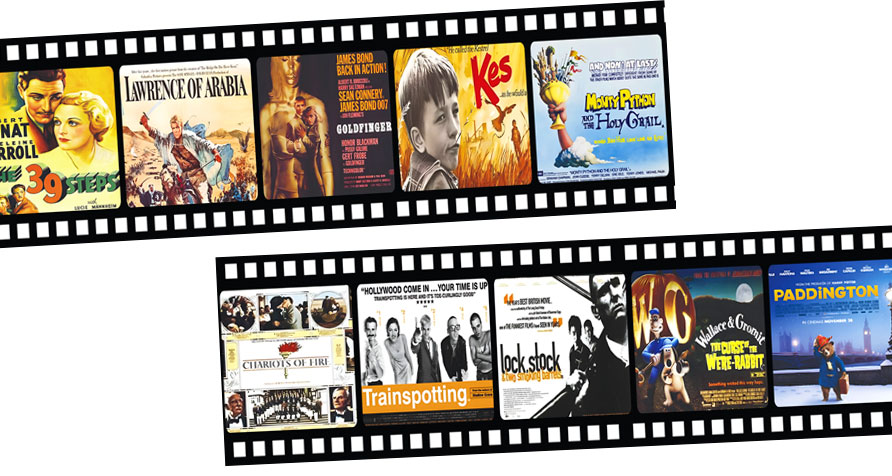
- The 39 Steps – 1935
- Lawrence of Arabia – 1962
- Goldfinger – 1964
- Kes – 1969
- Monty Python and the Holy Grail – 1975
- Chariots of Fire – 1981
- Trainspotting – 1996
- Lock, Stock and Two Smoking Barrels – 1998
- Wallace & Gromit: The Curse of the Were-Rabbit – 2005
- Paddington – 2014

Digital Edition
Bahrain This Month
October 2026
Related Articles
From Sakhir to Sepang
Mon, 05 Oct 2026

A Healthier Way Forward
Mon, 05 Oct 2026

The New Health Rules
Mon, 05 Oct 2026