
Saad Al-Essa
by: BTM - Fri, 04 Sep 2026
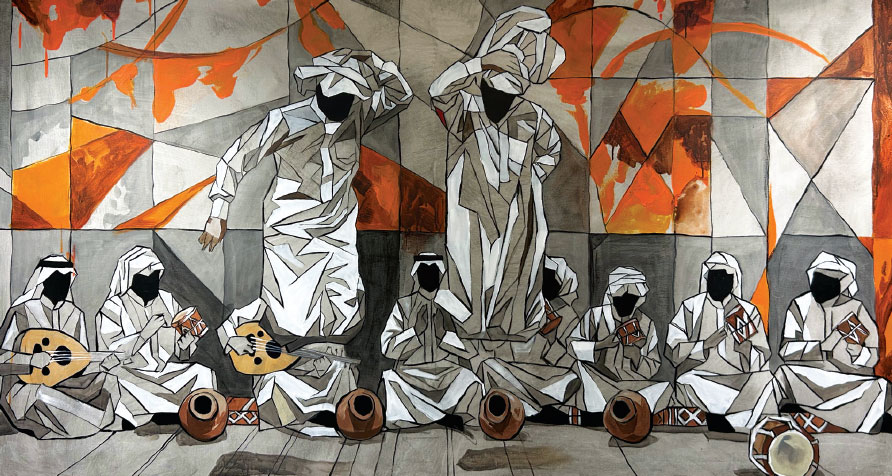
Bahraini artist Saad Al-Essa brings the Kingdom’s cultural heritage into a striking contemporary frame through his distinctive geometric style. For our September cover, his artwork Samrat turns to the traditional music and folk dances of the Arabian Gulf, celebrating a shared heritage shaped by generations of coastal communities.
What first inspired you to pursue your creative career?
I consider myself truly fortunate to have been blessed with this creative gift. My passion for art began early in life, driven by an instinctive desire to document visual memory and the environment around me. The turning point came when I realised that direct, realistic documentation felt too static. This sparked an exploratory journey, deconstructing scenes into visual energy and geometric masses. I moved through realism, caricature, digital art and surrealism before ultimately anchoring my work in geometric abstraction. That was the moment I knew I had found my true calling.
Your work blends bold geometric forms with modern Bahraini culture and heritage. How did this distinctive style develop?
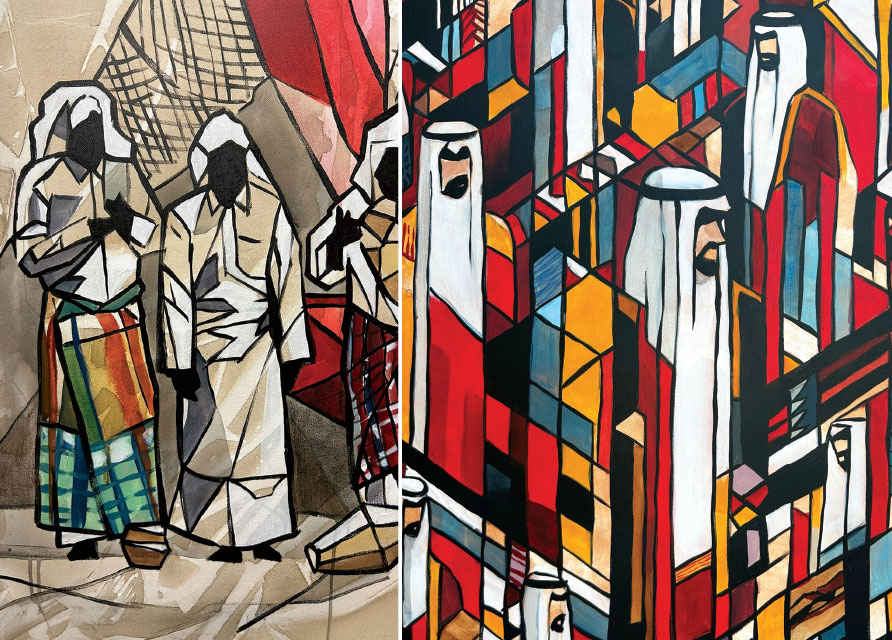
This style developed through an effort to strip subjects down to their essential architectural foundations. By merging contemporary cubism with Arabian Gulf identity, my practice shifted from representational drafting to bold compositions defined by sharp black outlines and faceted colour planes. The goal was to forge a visual language that gives our heritage a modern pulse attuned to today’s rapid cultural and architectural evolution.
You reinterpret Bahraini architecture, dress and everyday culture through geometric compositions. What draws you to these subjects?
I believe art is a universal language that needs no translator. The cultural landscape of the Arabian Gulf, and Bahrain in particular, is extraordinarily rich in visual elements that deserve global exposure. The rhythmic drape of Thobe Nashil embroidery, the angular geometry of the traditional Batoola, the curved hulls of wooden dhows (Boum) and the historic masonry of Muharraq are all anchored in powerful structural forms. Reinterpreting these everyday scenes highlights the timeless beauty embedded in our traditions.
How do you balance Bahrain’s heritage with a fresh, contemporary expression?
Balance comes from treating heritage as a living, evolving identity rather than a static museum piece. The soul of the work remains deeply rooted in the local environment through warm desert tones, deep maritime blues and human narratives, while the execution relies on spatial abstraction, layered textures and bold compositional structure.
What do geometry, lines and patterns allow you to express that a more traditional approach cannot?
Geometry cuts through surface detail to reveal the underlying balance and harmony of the composition. Obscuring direct facial features creates calculated ambiguity, inviting viewers to project their personal memories and emotions onto the canvas. Sharp, intersecting lines establish a visual tempo that balances dynamic movement with structural stillness.
Who or what has had the greatest influence on your creative journey?
My greatest and most foundational support has always come from my mother, whose early encouragement provided the confidence to pursue this path. Externally, participating in prominent art competitions, such as the Nasser bin Hamad Youth Creativity Award and the Yousuf bin Ahmed Kanoo Award, played a pivotal role in shaping my journey. These platforms fostered a healthy spirit of competitive excellence and offered vital recognition for creative expression.
What does success mean to you?
True success lies in creating a lasting emotional impact, where the viewer sees their own identity reflected in the work, forms a personal connection with the piece and connects with the underlying message.
How do you stay true to your vision as your work gains attention?
To stay authentic as recognition grows, I approach every canvas as an entirely new experiment, focusing on the exploration of the idea rather than external expectations.
How does creative inspiration drive your evolution as an artist?
Curiosity is my primary driving force. Evolving as an artist demands continuously stepping outside my comfort zone, whether by experimenting with unconventional scales and new painting surfaces or exploring fresh techniques, mixed media and raw materials that directly serve the core concept and amplify the message of the canvas.
Tell us about the inspiration behind our September cover. What does Samrat represent, and what did you want the piece to convey?
I chose the artwork Samrat for this cover because of its profound connection to Arabian Gulf culture as a whole. The piece celebrates our traditional music and folk dances, which originally served as a source of solace and entertainment for seafaring sailors enduring arduous voyages, fostering unity and resilience in times of hardship. This musical heritage transcended generations and remains a living tradition across Gulf states and coastal communities to this day.
Where will your artistic journey take you next?
Looking ahead, my scope is expanding beyond Bahrain to encompass the wider Arabian Gulf, exploring the deep-rooted cultural ties and shared heritage that unite the region.
Lastly, what advice would you give to young creatives beginning their own journey?
For emerging creatives, continuity in art comes through practice, and practice leads to perfection.
Digital Edition
Bahrain This Month
October 2026
Related Articles
A Legacy of Giving
Mon, 05 Oct 2026
A Patient-First Future
Mon, 05 Oct 2026
Bound By Brotherhood
Fri, 04 Sep 2026
Videos