














AI Is Replacing Jobs Faster Than You Think
by: BTM - Mon, 05 Oct 2026
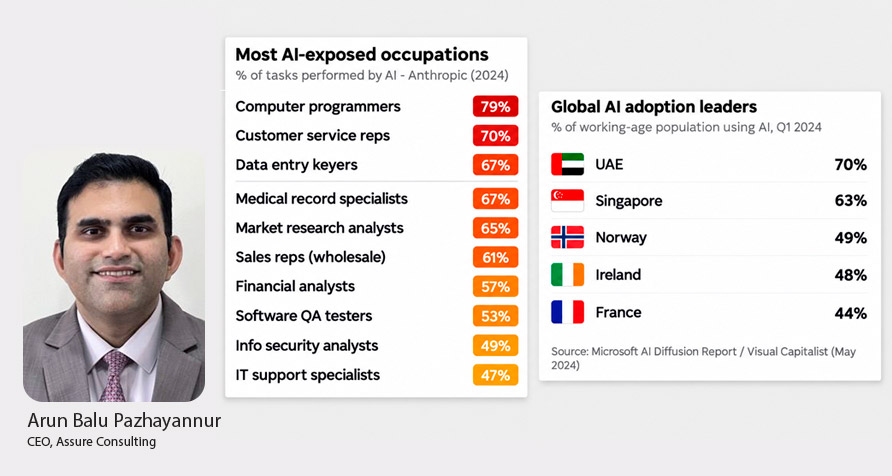
Over 200,000 workers have lost their jobs to AI in 2026, and it’s only August. In 54% of all layoff events this year, companies have explicitly cited artificial intelligence as the reason. That figure was less than 8% just 12 months ago.
Which industries are laying off staff?
Technology leads with over 56,000 job cuts in 2026, followed by IT services and consulting at 32,000. Finance is not far behind. Citigroup alone is targeting 20,000 job cuts by the end of the year. Retail, logistics and media are all reporting sharp reductions.
Which functions are disappearing?
Customer service, data entry, content moderation, basic coding, claims processing and back-office administration are being automated first. These are deterministic tasks: predictable, rule-based and repeatable. But the replacement does not stop there. AI is increasingly handling work that once required human judgement, such as legal research, financial modelling, marketing strategy and medical documentation.
The cost of building custom software has dropped so sharply that companies can now automate entire workflows that previously needed full teams performing manual tasks. A Stanford study found that employment among developers aged 22 to 25 had fallen by nearly 20% since 2022, while employment among experienced professionals remained stable. The pattern is consistent. AI replaces what can be taught from a textbook. Judgement, context and cross-domain thinking survive.
How widespread is AI already?
The UAE leads global AI adoption with 70% of its working-age population using AI regularly, followed by Singapore at 63%. The US, despite being home to most AI companies, ranks far lower at 28% for population-level use, though its enterprise adoption stands at 88%.
That gap tells a story. Large corporations are adopting AI fast, but the broader workforce is still catching up. Globally, 18% of working-age adults now use AI regularly. The most common tasks are writing, coding, research, document analysis and customer support.
What companies must do
Digitise. Move manual processes into digital form. Then digitalise. Redesign workflows around digital tools, not just replicate old habits on a screen. Then automate. Remove human effort from every repeatable task. Companies using AI report 40% productivity gains that translate directly into lower costs. Those that do not automate will be undercut by those that do.
David Epstein argued in Range that generalists outperform specialists in complex environments. That thesis is now playing out. Demand for generalist roles has grown by 42% year on year. The professional who understands multiple domains and directs AI across them is more valuable than several narrow specialists combined.
In our own practice, we have automated recruitment screening, KPI tracking, client follow-ups and payment collection. These tasks previously required dedicated staff.
The bottom line is uncomfortable but clear. Companies that automate now will compete. Companies that wait will spend the next five years explaining why they cost more for less.

Digital Edition
Bahrain This Month
October 2026
Related Articles

From Every Era: For Everyone
Fri, 08 May 2026

Cultivating Community and Nourishment
Mon, 05 Jan 2026

The Season’s Shopping Hub
Mon, 05 Jan 2026