








Trust in the Corporate World, Does It Really Matter?
by: BTM - Wed, 08 Jul 2026

Eman Deabil writes about why corporate trust may be less absolute than many organisations assume, arguing that accountability, governance and role clarity matter just as much.
Trust is one of the most frequently invoked words in corporate language. Leaders praise it, speakers celebrate it and organisations proudly list it among their core values. Yet, in practice, trust is often treated as a universal remedy, assumed to be inherently good, unquestionably necessary and largely self-explanatory.
What is rarely examined is whether trust, as it is commonly used in corporate contexts, is truly operational. Even less attention is given to how it is built, how it is assessed or whether it actually drives execution and performance. Global thought leaders continuously emphasise the importance of trust, but they rarely explain how to create it, maintain it or improve it.
Throughout my career, I have observed situations that have led me to question the way trust is framed inside organisations. This reflection may be uncomfortable and it may be controversial, but it is worth examining. Rather than repeating familiar management clichés, this piece looks at trust through a different lens, one that challenges the assumption that organisations succeed because of trust rather than because of the systems, controls and structures designed to function precisely when trust is limited.
Oxford defines trust as: “a firm belief in the reliability, truth, ability, or strength of someone or something.”
Another widely cited definition states: “Trust is the willingness of a party to be vulnerable to the actions of another party based on the expectation that the other will perform a particular action important to the trustor.” (An Integrative Model of Organizational Trust, 1995)
At its core, trust involves two parties. One becomes vulnerable and forms an expectation, while the other is expected to act in a way that matters to the former.
The first reflection is that there is no such thing as absolute trust and, in organisational settings, it is neither realistic nor achievable. If absolute trust were possible, there would be no need for three lines of defence, no risk or compliance functions, no audit, no governance frameworks and no performance reporting. The very existence of these mechanisms signals an implicit assumption that threat, failure, bias and error are always possible.
The second reflection is that trust in the corporate world is multi-dimensional. It varies by category, degree and context. We trust different people for different things.
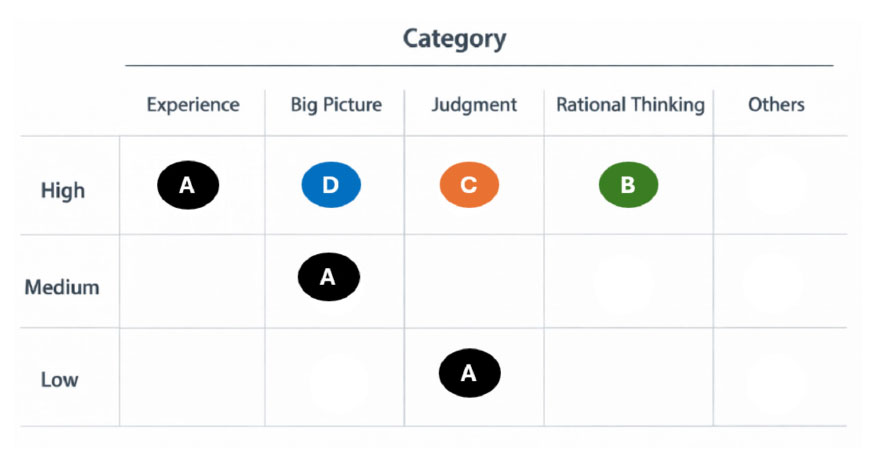
You may trust A’s experience to deliver on time, B’s rational thinking and wisdom, C’s judgement or D’s ability to read the big picture and build connections. You might trust A across several categories, but not all of them. In the corporate world, it is nearly impossible to trust someone in every category.
Even within the same category, trust is relative, which takes us to the second dimension: degree. We rank individuals implicitly based on experience, track record and outcomes. A might rank first in several categories, while you may trust B more than C in a specific area. Imagine placing those individuals in a grid with two axes, category and degree.
The third dimension, context, further complicates matters. Judgement that appears sound in isolation may become biased when the individual is personally involved in the decision at hand.
The third reflection is that time does not guarantee trust. In high-risk environments, execution often occurs without the luxury of time-based trust-building. Airline crews operate daily with captains they may have never flown with before. Structure, training, reputation and role clarity compensate for the absence of personal trust.
This leads to a more fundamental question: do organisations truly need trust in order to perform and execute?
Perhaps trust, as commonly framed, is an overstated value in corporate settings. What organisations actually rely on are clear accountability, robust governance, defined roles and responsibilities, clear decision-making mechanisms and systems that work even when trust is partial or absent.
A powerful illustration comes from the drama Chernobyl. Three men entered the flooded basement beneath the reactor to open valves and prevent a second catastrophic explosion. They had never met before, yet they relied on one another with their lives at stake. This was not trust built over time, nor trust grounded in culture statements or values workshops. It was trust driven by clarity of purpose, role alignment and a shared understanding of consequence.
This was about their lives and the lives of others, not about meeting a project deadline, delivering a management report, developing a concrete plan or following a documented process.
Final Thought
Trust, as it is often used in corporate language, may be more aspirational than operational. Organisations do not function because of absolute trust. They function because they are built on checks, balances, accountability and role clarity. Perhaps the real risk is not a lack of trust, but the illusion that trust is a fundamental value.
Digital Edition
Bahrain This Month
October 2026
Related Articles

A Bigger Football Stage
Mon, 05 Oct 2026

Mindful Money Matters - The Many Values of Money
Mon, 05 Oct 2026

Making Money Make Sense
Mon, 05 Oct 2026