




















A Journey into the Genesis of Italian High-Tech
by: BTM - Sat, 07 Nov 2026
From Rome’s ancient monuments to engineering achievements across the Mediterranean, Italy’s technological heritage reveals how innovation, artistry and ambition have shaped structures that endure today.
There is a secret, invisible yet indelible red thread running through the centuries, linking imperial remains across the broader Mediterranean to the audacity of modern buildings. The connection lies in the Italian inclination to challenge the limits of gravity and matter, transforming scientific rigour into tangible emotion, beauty and strength. It is a testament to working with passion, perfection and heart: the same spirit that guides our diplomatic work here in Bahrain every day.
What we today define as Italian high-tech has roots that reach far beyond post-war industrial laboratories. Its genesis lies in an ancient memory, in an age-old fascination with form becoming structure and technology becoming poetry. This extraordinary heritage continues to place Italy at the centre of the international stage, where preserving the past merges with the most challenging innovations of modern times. Our Bel Paese offers a lesson in beauty that continues to fascinate both the eyes and the minds of its visitors.
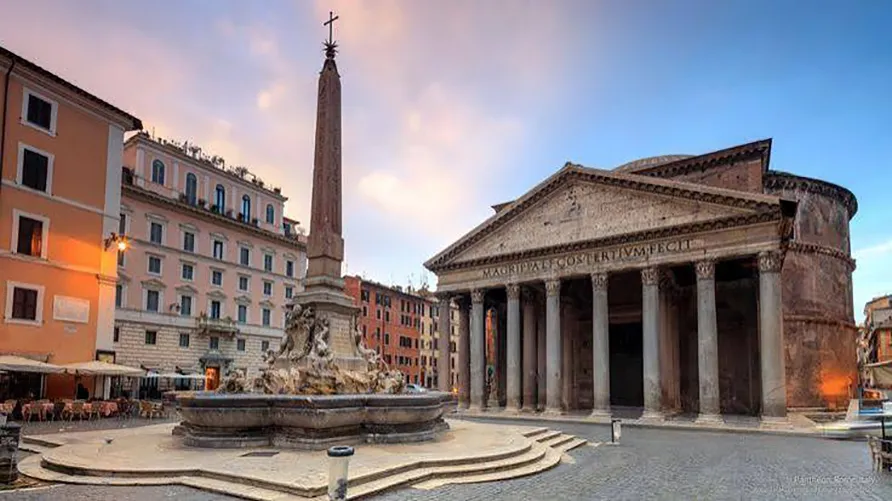
Let us begin with an enduring testament to this culture: the Pantheon. Long before modern steel and glass redefined the global skyline, it stood as a monument to engineering ambition and architectural mastery. Its origins date to around 27 BC, when Marcus Vipsanius Agrippa, Emperor Augustus’s trusted son-in-law, commissioned the original temple. Rebuilt after devastating fires, it took its present form under Emperor Hadrian in the second century AD.
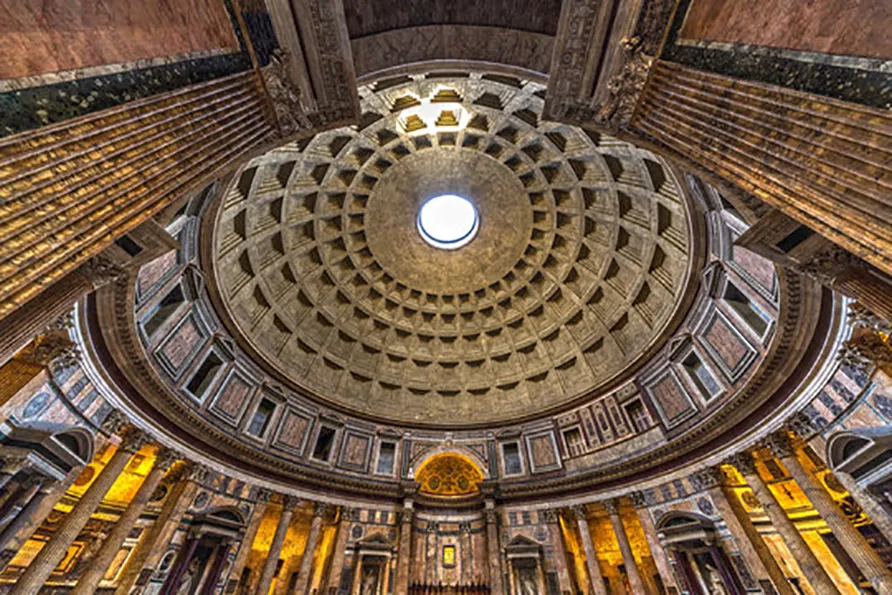
Even today, crossing its massive doorway means opening your eyes to an engineering miracle that seems to defy physics. Above your head rises the world’s largest unreinforced concrete dome, crowned by an oculus approximately nine metres across.
But a particularly magical moment arrives on 21 April, the traditional anniversary of Rome’s foundation in 753 BC. Around midday, a beam of sunlight pierces the oculus, cuts through the darkness and illuminates the entrance with remarkable precision. The Pantheon ceases to be a mere stone building and becomes a gigantic cosmic machine: a planetarium of light conceived almost two thousand years ago by engineers who seemed to speak to the future.
The spectacle changes with the seasons. At the winter solstice, when the sun follows its lowest path across the sky and daylight hours are shortest, the midday beam falls high on the dome. Light and architecture mark the passage of time, revealing a relationship between the building and the heavens that still inspires wonder.
 A comparable interplay of light and architecture can be witnessed at Egypt’s Great Temple of Abu Simbel. Built in the 13th century BC and relocated in 1968, it admits sunlight deep into its sanctuary on 22 February and 22 October, illuminating statues within. Across these ancient monuments, scientific precision becomes an experience of beauty and awe.
Another timeless classic comes to mind: have you ever visited the Trevi Fountain? Many recall Anita Ekberg’s iconic scene in La Dolce Vita or Nicola Salvi’s breathtaking Baroque façade, completed in 1762. Yet the water flowing through it carries a much older legacy. The fountain is fed by the Aqua Virgo, or Acquedotto Vergine, inaugurated by Agrippa in 19 BC. Running largely underground for more than 20 kilometres, it is the only one of ancient Rome’s eleven major aqueducts to have remained continuously in use.
Roman hydraulic and civil engineering remain part of daily life, while ancient aqueducts still stand in Rome’s Appian Way Regional Park. This mastery of water also found expression in grand imperial retreats such as Hadrian’s Villa and, centuries later, Villa d’Este.
This language of modularity, durability and technical intuition did not remain confined to Rome. It crossed seas and deserts, leaving an indelible mark across the known world. Rome left monuments alongside infrastructure: cities, bridges, harbours, roads and theatres. Some survive as ruins, like those in Pompeii; others retain public and cultural functions that span centuries.
To grasp the full scale of Roman engineering, we must look beyond the capital, across the Alps and the Channel, to North Africa and the Levant. In Italy, the Arena of Verona offers a compelling example of the enduring dialogue between antiquity and modern life. Further south, the ancient theatres of Taormina and Catania reveal how Roman builders adapted inherited architectural traditions to local topography. Taormina’s theatre hosted a concert for leaders attending the 43rd G7 Summit in 2017.
 Across Europe, remarkable achievements survive: the towering Pont du Gard aqueduct in southern France, the Roman Baths in Bath and the monumental fortifications of Hadrian’s Wall. Roman roads helped shape European transport, linking communities across vast distances. This network also shaped imperial history. In Eboracum, the Roman fortress that became York, Emperor Septimius Severus died and Constantine the Great was acclaimed emperor by his troops.
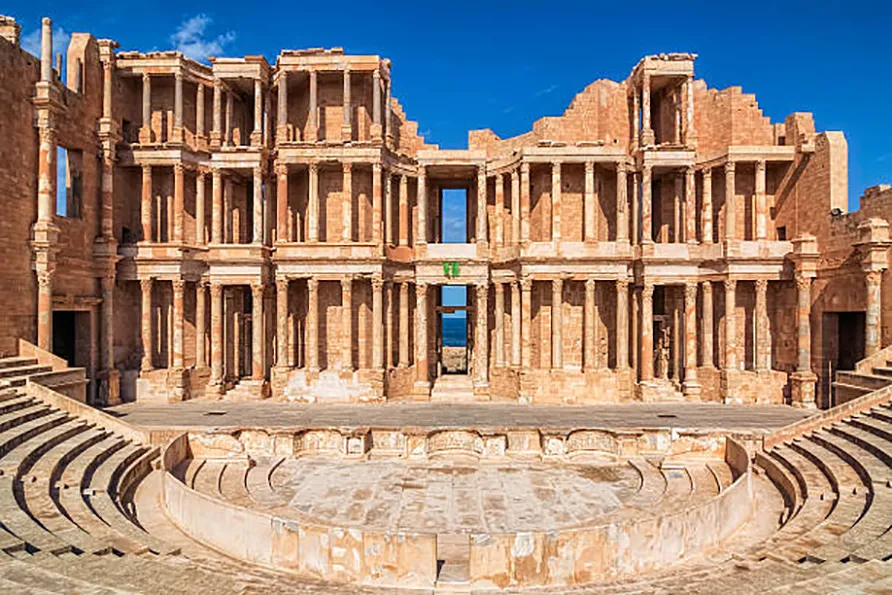
Across the Mediterranean in Libya, Leptis Magna and Sabratha demonstrate the scale of Rome’s engineering enterprise. Dramatically expanded under Septimius Severus, Leptis Magna preserves the footprint of an ambitious urban system: monumental public spaces, imperial baths, markets and a sophisticated harbour highlighting the importance of maritime commerce. At Sabratha, the extraordinary Roman theatre rises against the Mediterranean horizon, one of the ancient world’s most evocative architectural survivals.
Libya’s capital offers another connection. Tripoli derives from the Greek Tripolis, meaning three cities: Leptis Magna, Sabratha and Oea, the site of modern Tripoli. Within the capital’s Old City, the Arch of Marcus Aurelius remains a magnificent reminder of this ancient heritage.
This legacy is also linguistic. Zaragoza in Spain derives from Caesar Augusta, while Friuli in north-eastern Italy stems from Forum Iulii. Centuries later, classical names crossed the Atlantic. New York State is home to Syracuse, Utica and Scipio, while Naples and Venice in Florida are among many American cities carrying Italian names.
In Jordan, Jerash and Gadara preserve theatres, colonnaded streets and monumental gateways that reveal the sophistication of Roman urban planning beyond the imperial heartland. In Amman, the Roman Theatre, built in honour of Emperor Antoninus Pius, was conceived as a place where thousands could gather to share a performance, a spectacle or a defining moment of public life.
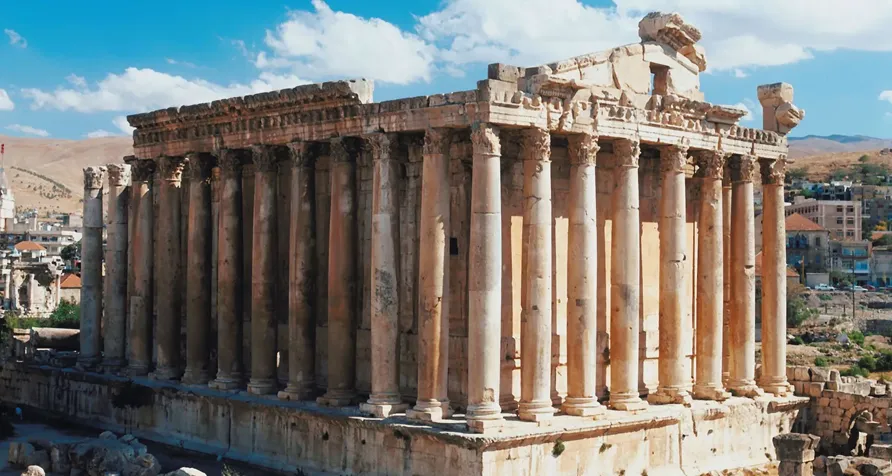
In Lebanon, Baalbek stands as a monumental expression of Roman architectural ambition. Its immense temples and carefully articulated stonework demonstrate a mastery of material, proportion and construction on an extraordinary scale.
These are just a few examples of a cultural and technological legacy: building methods and an ability to organise space that continue to resonate. Some structures remain in use; others survive as archaeological sites. Together, they tell a story of ingenuity that transcends borders and centuries.
From the Pantheon’s concrete dome to Italy’s amphitheatres, from North Africa’s harbours to the theatres of the Middle East, Roman engineering offers a lesson central to contemporary high-tech architecture. Innovation is the art of understanding matter, shaping space and creating structures capable of living across generations.
Tags #btm november 2026 #italy in bahrain 2026 #italy in bahrain #embassy of italy bahrain #Embassy of Italy #italy bahrain cultural relations #roman monuments mediterranean #ancient roman engineering innovations #italian architectural heritage #roman aqueducts and architecture #pantheon rome engineering #roman architecture and technology #ancient roman engineering #italian engineering history
Digital Edition
Bahrain This Month
November 2026
Related Articles
A Friendship That Feels Like Family
Sun, 08 Nov 2026
Shared Horizons
Sun, 08 Nov 2026
The Italian Touch
Sun, 08 Nov 2026